Buildings of José Borobio Ojeda
6 buildings

Zaragoza, 1907-1984
José Borobio Ojeda was born in Zaragoza in 1907 into a wealthy family with a sensitivity towards culture and art. His father, a paediatrician by profession, encouraged him from an early age with a solid education and taught him an appreciation for the humanities. From a young age, he showed a great talent for drawing, a hobby that, over the years, came to complement his professional activity. Around 2,500 of his drawings are preserved in the family archive.
In 1923, following in the footsteps of his older brother, Regino, he began his architectural studies in Madrid and earned his degree in 1932. While he was at university, the School of Architecture was going through a transition between the languages inherited from tradition and the emerging European rationalist currents. Borobio was a disciple of architects like Modesto López Otero and Pedro Muguruza, who gave him rigorous technical training, as well as instilling in him an interest in the new possibilities of the modern language. He shared studios with architects such as Luis Moya and Rafael Aburto, with whom he maintained a close professional and personal relationship. In Madrid, he also worked as a cartoonist for the weekly humour magazines Buen Humor and Gutiérrez, and he collaborated with the agricultural magazine Agricultura; he participated in the Madrid Cartoonists’ Society and was a member of the Union of Spanish Cartoonists.
After earning his degree, he returned to Zaragoza, where he spent most of his career. Even before finishing his studies, he was already working during holiday periods at his brother Regino’s architectural studio, where he also returned to work when he relocated to Zaragoza permanently. The younger brother’s arrival brought a shift towards rationalism in the firm’s designs. He was one of the pioneers in introducing a rationalist language into Aragonese architecture. The early years of his career were largely dedicated to public architecture. During the Second Republic, he received various institutional commissions, such as the renovation of municipal buildings and the construction of social housing and educational facilities in rural areas in his role as a school architect for the province of Huesca. He was also a professor of technical drawing at the School of Arts and Crafts in Zaragoza, where his influence as an educator was evident. His commitment to the profession was reflected in his participation in the founding of the Architects’ Association of Aragon, Navarre, and La Rioja, and his role as secretary of the Board for the delegation in Zaragoza through 1954. He is considered a key figure in professionalizing the architectural profession in the region.
His passion for drawing extended to include painting, and in the 1930s, he received commissions as a muralist, an activity he pursued together with the Codín brothers, who had continued in their father’s profession as decorators and set designers. Notable examples in this field include the decorative mural for the Salduba café-restaurant in Zaragoza, which no longer exists.
The Civil War abruptly interrupted his career. When the war broke out, he was camping in the Aragonese Pyrenees and was unable to return to Zaragoza. He lived in Barcelona for over a year, where, since he was unable to practice as an architect, he put his considerable talents as a draftsman to good use by painting ambulances and vans, creating propaganda posters and signposts for shelters, and decorating trucks for the wartime Medical Council. Once he returned to Zaragoza, he trained to become a provisional lieutenant at the Military Academy in Burgos, where he completed his training in mid-August 1937. Later, he took part in the Spanish Civil War on the Nationalist side. From then on, he became a chronicler of the conflict, leaving a record of the war through four albums of drawings he did on the front lines in Aragon and Catalonia. At the end of the war, he also designed stages for political memorials, incluiding for Victory Day and for the reception of leaders from Italy’s fascist regime.
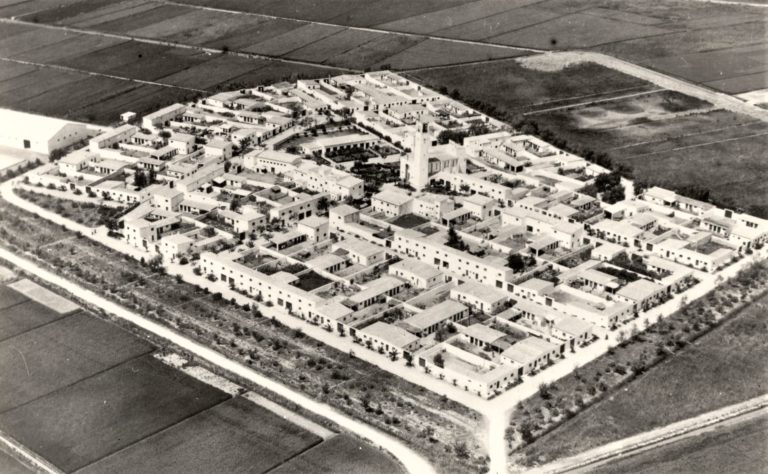
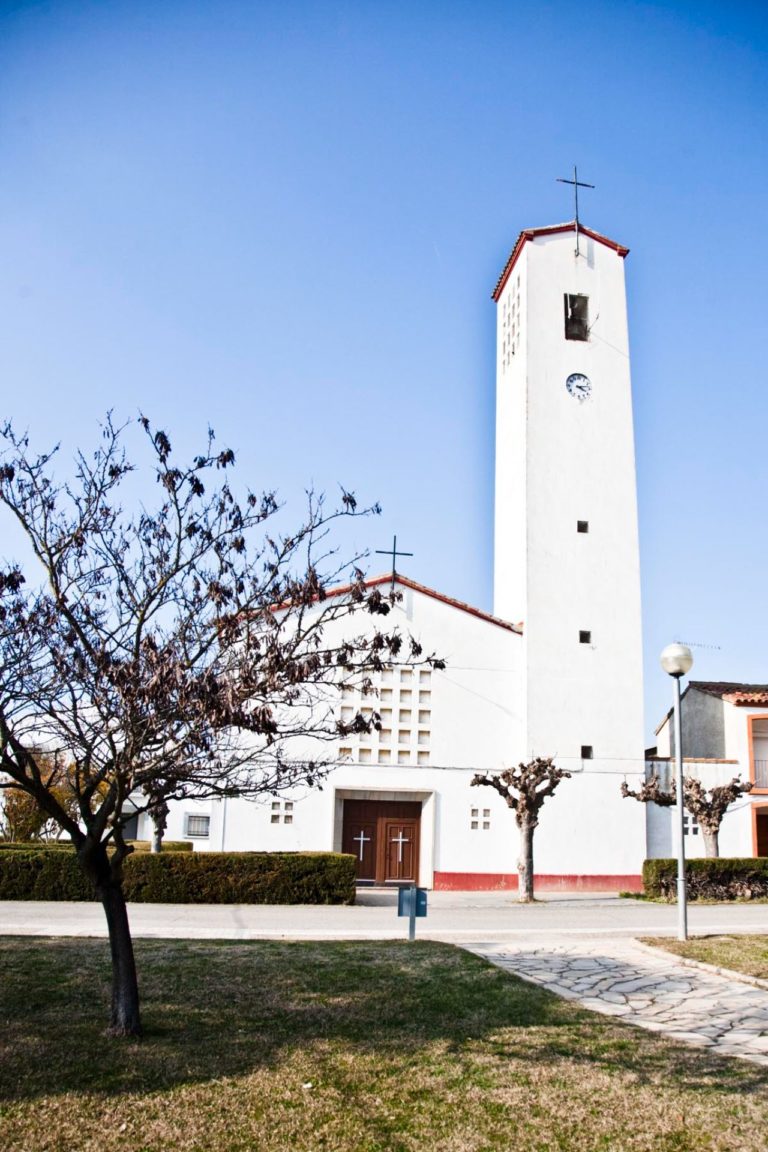
After the war, Borobio returned permanently to Zaragoza and resumed his professional activity at the Borobio Studio. He got married and had three daughters. The new political context was not unfavourable to him: in 1944, he took a position as an architect at the National Institute of Colonization (INC), in the Ebre Regional Delegation, a position he held until his retirement in 1977. For the INC, he designed and directed the construction of 31 new towns, located mainly in Aragon and Catalonia (especially in Lleida and the Ebre River Delta). However, he was forced to adapt to the architectural guidelines of the Franco regime, at odds with the rationalism he had championed since his university days. He maintained a low profile in public, focusing on his family life, although in his work he never completely left behind the modern language he had embraced in his youth.
During the 1950s and 1960s, he expanded his field of action with projects in urban planning and land use, collaborating with engineers and experts on regional development plans. In 1965, he earned his PhD in architecture, and in 1971, he was appointed consulting architect to the Bank of Spain for the regions of Aragon and La Rioja.
In parallel to his professional work, he participated actively in Zaragoza’s cultural life: he contributed to technical journals, gave lectures, and fostered architectural debate in the context of Aragon. He mentored young architects who would later breathe new life into the region’s architectural landscape.
He died in Zaragoza in 1984, known as a discreet but essential figure in the modernization of 20th-century Aragonese architecture. Although he largely avoided the media spotlight, there has been a renewed focus on his work and his ideas in recent studies and exhibitions, which have situated him as one of the pioneers of rationalism on the regional level in Spain.
Biography by Roger Subirà
Bibliography
BERGERA SERANO, Iñaki, ESTABÉN BOLDOVA Daniel, Regino y José Borobio, arquitectura y fotografía, Institución Fernando el Católico, Zaragoza, 2016.
VÁZQUEZ ASTORGA, Mónica, José Borobio 1907-1984 una vida y una época contados a través de imágenes, Institución Fernando el Católico, Zaragoza, 2008.
VÁZQUEZ ASTORGA, Mónica, José Borobio. Su aportación a la arquitectura moderna, Delegación del Gobierno en Aragón, Zaragoza, 2007.
LABORDA YNEVA, José, Confederación Hidrográfica del Ebro, Zaragoza, 1933-1946 Regino y José Borobio Ojeda, Colección Archivos de arquitectura, España Siglo XX, Colegio de Arquitectos de Almería, Almería, 2001.
Borobio Ojeda, José, Cien dibujos de arquitectura y otros más, Institución Fernando el Católico, Zaragoza, 2000.
MATEO, Josep Lluís, “Sobre Zaragoza: en torno a la arquitectura zaragozana de Regino y José Borobio”, in Jano 58, June 1978.
AA VV, Regino y Jose Borobio, Ediciones de Arquitectura Edarba, Madrid, 1936.