Buildings of César Manrique
3 buildings

Arrecife, 1919-Teguise, 1992 (Lanzarote)
Born in Arrecife (Lanzarote), César Manrique maintained close ties to his native island throughout his professional career, making one of the most unique and esteemed contributions to the relationship between art, architecture, landscape, and the territory in 20th-century Spain. His name became intimately associated with the culture and collective imagination of Lanzarote, due to his decisive role in shaping its contemporary image based on an integrative vision committed to the natural and cultural environment.
He began his artistic training at the School of Arts and Crafts in Arrecife, and after the Spanish Civil War, he moved to Madrid to study at the San Fernando Academy of Fine Arts, graduating in 1945. During that period he came into contact with the main cultural circles in the capital and the artistic debates of the time, consolidating a solid pictorial foundation that influenced the subsequent development of his work.
Throughout the 1950s, he began to exhibit regularly and to experiment with more abstract languages. In 1964, he settled in New York, where he lived for several years and became familiar with international artistic movements such as abstract expressionism, pop art, and kinetic art. This experience proved decisive in the evolution of his artistic language and in the formulation of an idea of art that lends itself to integration with space and with its surroundings.
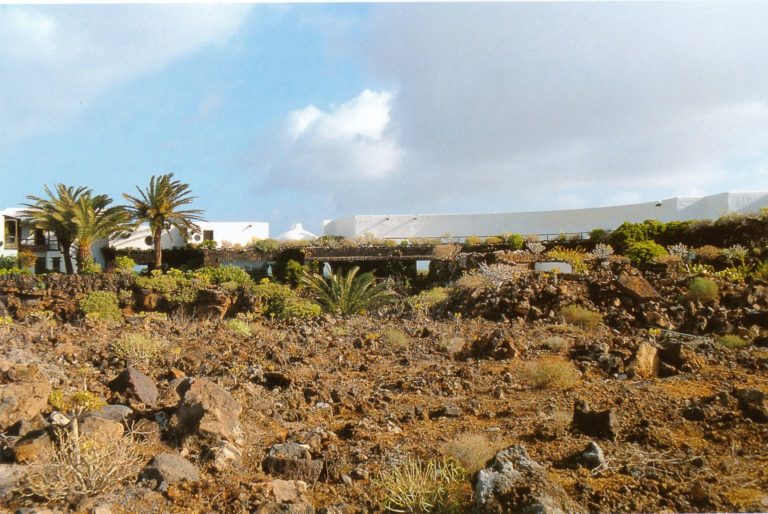
In the late 1960s he returned permanently to Lanzarote, beginning the most significant phase in his career. From that time forward, his work centred on direct intervention in the territory, and he developed a pioneering vision that advocated compatibility between economic development, tourism, and landscape preservation. His practice was characterized by an integration of architecture, sculpture, and design in pre-existing natural spaces, using the volcanic topography as an essential design material and as a support for an ethical and aesthetic reflection on the relationship between nature and human creation.
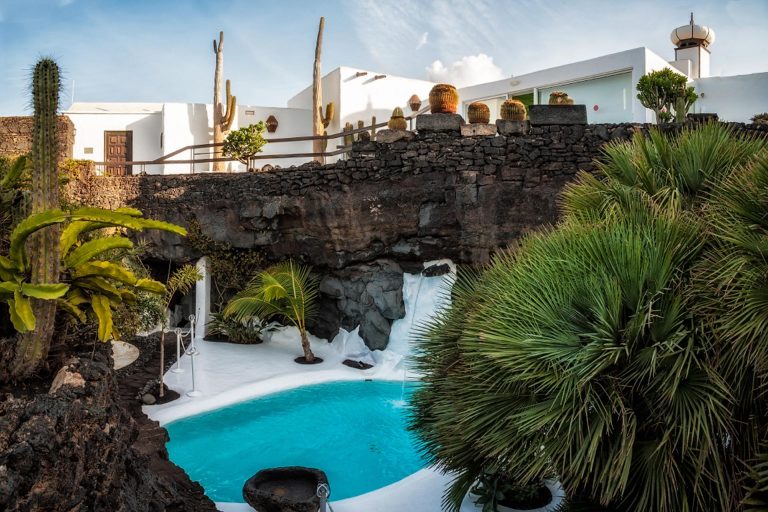
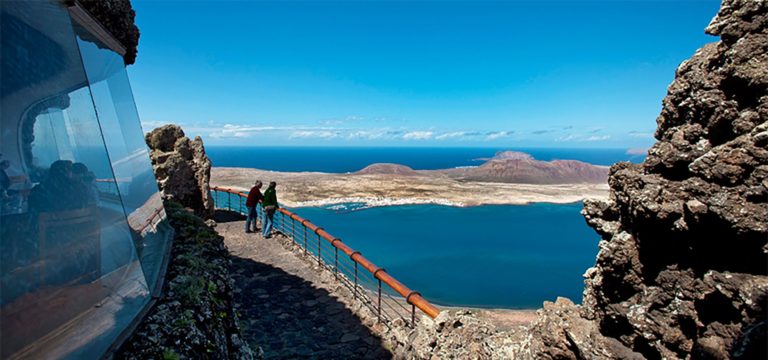
His most emblematic achievements are spaces designed simultaneously as works of art and public facilities, associated with a conception of tourism that respects the environment. Highlights include Jameos del Agua, the River Overlook, the Cactus Garden, various interventions in the Timanfaya National Park, and Lago Martiánez in Puerto de la Cruz (Tenerife). They all combine spatial, plastic, and environmental criteria, resulting in an architecture devoid of rhetorical gestures, deeply rooted in the place, and distanced from conventional tourist models.
At the same time, Manrique played an active role as a defender of the island landscape, promoting aesthetic and regulatory criteria that limited the height of buildings, regulated the use of colour, and protected the traditional image of the urban settlements in Lanzarote. His commitment to the territory made him critical of speculative urban development processes and, in the final years of his life, he repeatedly expressed his concern about the growing tourist pressure that threatened the balance on the archipelago.
He occupies a central place in contemporary Spanish culture, not only for the originality of his work but because, through his comprehensive artistic practice, he anticipated fundamental present-day concepts in architecture and urban planning such as sustainability, the identity of place, and a respectful intervention in the landscape.
The César Manrique Foundation, created by the artist himself in 1982, acts as guarantor of his intellectual and creative legacy, ensuring the conservation, study, and dissemination of his work. From its headquarters in Lanzarote, the institution maintains the guiding principles behind his thought and practice, promoting a critical and committed vision for the protection of the landscape, culture, and territory.
Biography by Roger Subirà
Bibliography