Buildings of Leandro Silva Delgado
4 buildings

Salto (Uruguay),1930-Segovia, 2000
Leandro Silva was born in the city of Salto, the capital of the Uruguayan region of the same name, located in the northwest of the country and named for its many waterfalls, and characterized by the presence of the river. He is recognized for his work on the landscape, which he developed through the visual arts as well as the design and construction of gardens.
His initial training was in drawing and painting, under the guidance of teachers like José Cuneo Perinetti, a central figure in landscape painting in Uruguay, and the Hungarian José Cziffery, a disciple of Henri Matisse. Although his first approach to landscape was pictorial, he soon turned his interest towards designing gardens, which led him to enrol in the Faculty of Architecture, Design and Urbanism at the University of the Republic (Uruguay) in 1954, thus consolidating his vocation as a landscape architect. The real turning point in his career began in 1957, when he spent an extended period in São Paulo working in the offices of Roberto Burle Marx, with whom he became a close collaborator and personal friend.
In the 1960s, he moved to Europe, where he taught extensively at the National School of Architecture of Versailles, one of the leading international centres in the field of landscape architecture. At the same time, he studied at the Higher School of Fine Arts in Paris, furthering his knowledge of engraving and painting. His move to Europe was fundamental to the dissemination of Burle Marx’s work – and, more broadly, modern South American landscape architecture – in the European context.
In 1969, he moved to Spain, which became the main focus of his professional practice. He developed some of his most important work in that country, establishing himself as a central figure in landscape architecture in the second half of the 20th century. His work is characterized by its ability to articulate the tradition of the Spanish garden – and, in particular, the Hispano-Arabic garden – with the biomorphic forms and principles of modern landscape design, especially those derived from the influence of Burle Marx.
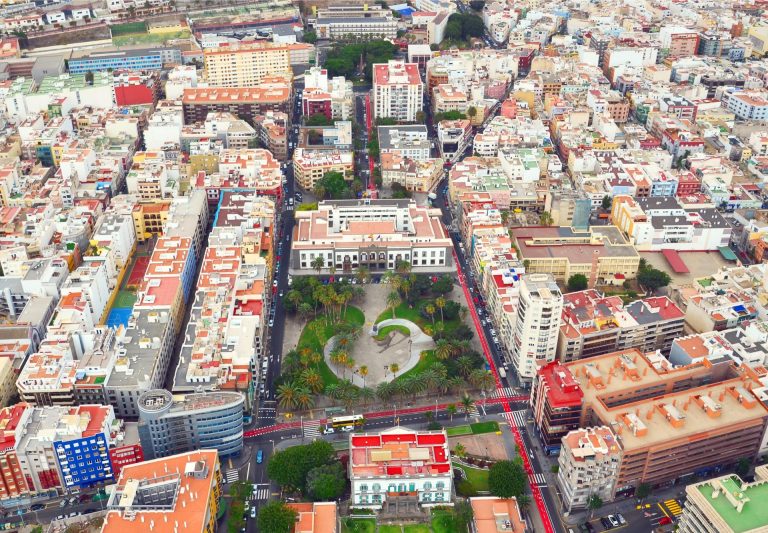
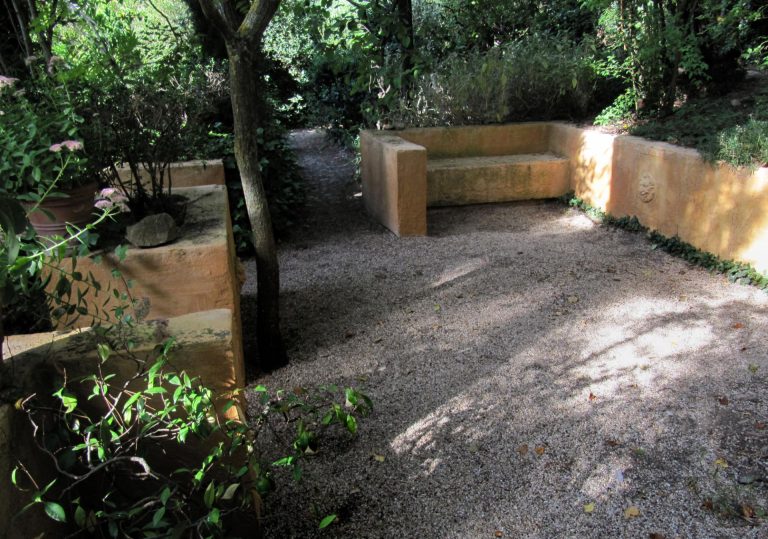
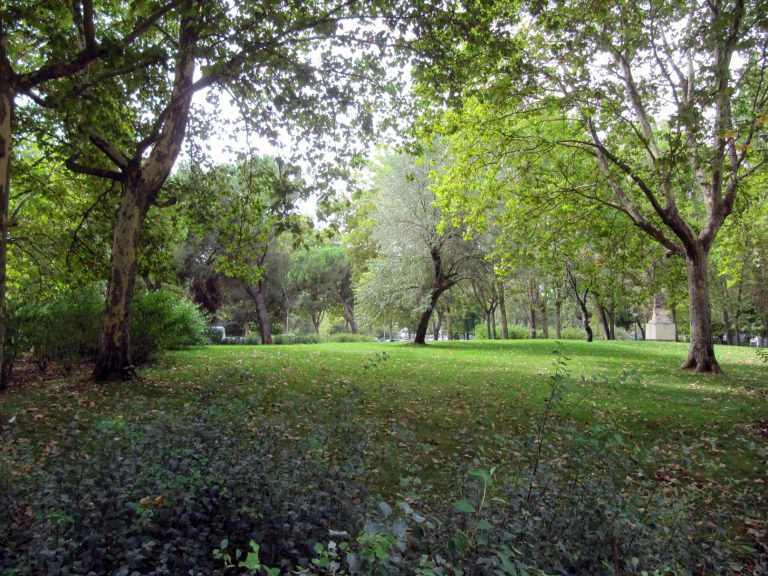
His most outstanding projects include the restoration of the Royal Botanical Garden in Madrid, aimed at recovering its original eighteenth-century character. In later projects, he introduced more freedom into his design language, contributing to defining the modern garden in Spain through works such as the Red Cross Park in Burgos, the Romeral de San Marcos in Segovia, the Plaza de Pérez Galdós in Las Palmas de Gran Canaria, and the gardens of the Torre Picasso, the Palomeras Park, the gardens of the Bank of Spain (Canillejas), and the monument to Gregorio Marañón in the University City, all in Madrid.
Alongside his work as a landscape architect, he collaborated as an architect and artist on projects with figures such as José Antonio Corrales and Ramón Vázquez Molezún or Antonio Fernández Alba. As a painter and visual artist, he exhibited in various galleries and museums and represented Spain in a number of biennials.
Leandro Silva’s professional archive was donated by his widow to the ETSAM and is held at the school’s library; it offers a valuable documentary collection for the study of his work and the development of contemporary landscape design.
Biography by Roger Subirà
Bibliografía