Buildings of César Ortiz-Echagüe Rubio
5 buildings

Madrid, 1927-
César Ortiz-Echagüe Rubio was born in Madrid on 13 January 1927. He was the fourth of eight siblings and grew up in a family with strong ties to the business world on his father’s side and noble ancestry on his mother’s side. Both sides of the family were also closely affiliated with the highest ranks of the army engineering corps. There were also many artists in the family: his uncle, Antonio Ortiz-Echagüe, was a prominent painter, and his father, José Ortiz-Echagüe, was an internationally renowned photographer, aviator, pioneer of the Spanish aeronautical industry, engineer, and founder of CASA (Construcciones Aeronáuticas SA) and SEAT, companies that played a significant role in his son’s professional career.
César Ortiz-Echagüe attended secondary school at the German School in Madrid and graduated in 1945. That same year, he joined Opus Dei. His ties to the group had a profound impact on his personal journey, culminating with his being ordained by Pope John Paul II in Rome in 1983, at the age of 56. In 1947, he began his architecture studies at the Madrid School of Architecture (ETSAM). In June 1952, he won the annual prize from the Royal Academy of Fine Arts of San Fernando for his final degree project. Through his relationship with Opus Dei, in 1967 he actively participated in the creation of the Architecture School at the University of Navarra, where he was appointed extraordinary professor.
His professional career began with commissions from companies founded by his father. The first of these, the SEAT workers’ dining hall, was designed with Manuel Barbero Rebolledo and Rafael de la Joya, and won the Reynolds Prize for construction innovation from the American Institute of Architects in recognition of its pioneering use of aluminium. For this project, the architects collaborated with the aeronautical engineer Ricardo Valle, who worked at CASA, another of the companies founded by Ortiz-Echagüe senior. During the construction of the SEAT building, Ortiz-Echagüe partnered with Rafael Echaide Itarte. The automotive company gave the new architecture firm, called Ortiz-Echagüe-Echaide, important commissions, some individually and others, again, in collaboration with Rebolledo and De la Joya. Between 1954 and 1964, the firm designed the SEAT headquarters in Barcelona and Seville, the laboratories and central warehouses in Madrid, as well as various branches for Banco Popular in the capital, among other projects. The studio, characterized by a modern and efficient organization, achieved remarkable success.
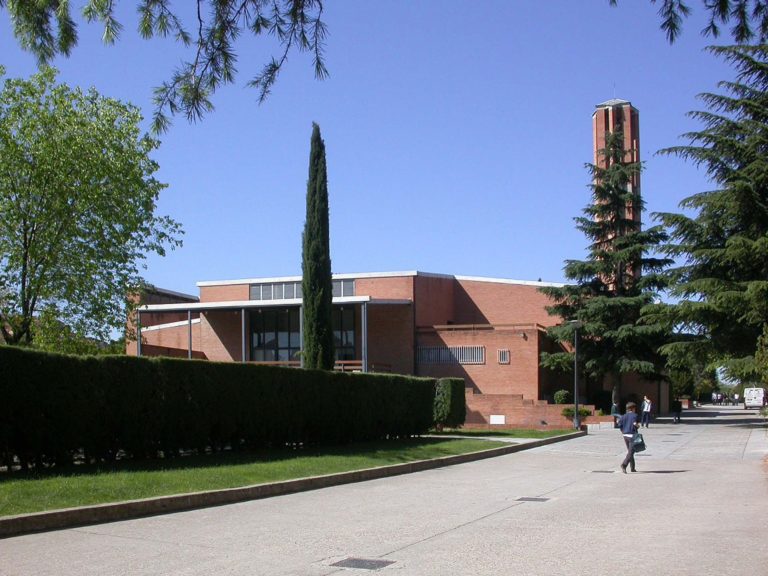
Over time, Ortiz-Echagüe’s work shifted towards educational architecture, with notable projects such as the Tajamar Secondary School in Vallecas – his final collaboration with Echaide – and the Retamar School in Somosaguas. The influence of Mies van der Rohe can be seen in all of these designs, with strictly modulated metal structures and a meticulous attention to detail. This rationalist and structuralist approach, defined by some specialists as “technological functionalism,” situated Ortiz-Echagüe and Echaide among the pioneers in Spain in the use of the rationalist language associated with rolled steel structures.
In parallel to his professional and teaching activity, Ortiz-Echagüe played a significant role in promoting Spanish architecture in Europe during the 1960s, publishing articles and contributing to the Swiss magazine Werk. He was also the author of several books intended to offer a broad picture of Spanish architecture to international audiences.
In 1974, he was accepted into the Bavarian Academy of Fine Arts, where Eduardo Chillida was already a member. In 1975, he moved to Rome and, after being ordained, began to gradually distance himself from architectural practice. A decade later, in 1984, he settled in Germany, where he remained until his return to Spain in 2015.
At the XI Ibero-American Biennial of Architecture and Urbanism (BIAU), held in Asunción, Paraguay in 2019, he received the Ibero-American Prize together with the architect Jorge Enrique Scrimaglio, in recognition of his role as “a solid benchmark in Ibero-American architecture over the years from its marked marginal and peripheral condition.”
Biography by Roger Subirà
Bibliography